



The Hellboy Universe is expanding once again, this time into the Old West with Carmen Red Claw: Belly of the Beast, a new two-issue series from Dark Horse written by Mike Mignola with art by Rae Allen. And in the series, as it turns out, the look of the title character was vitally important.
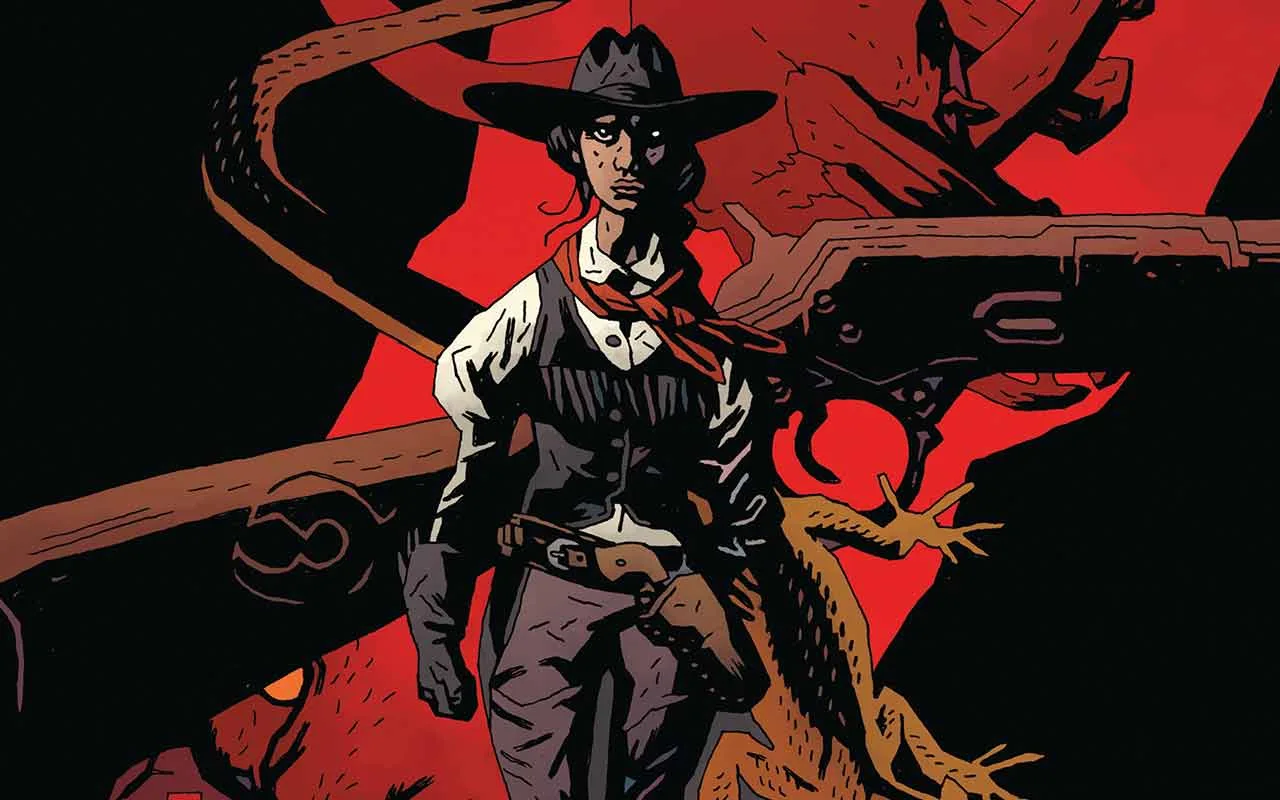
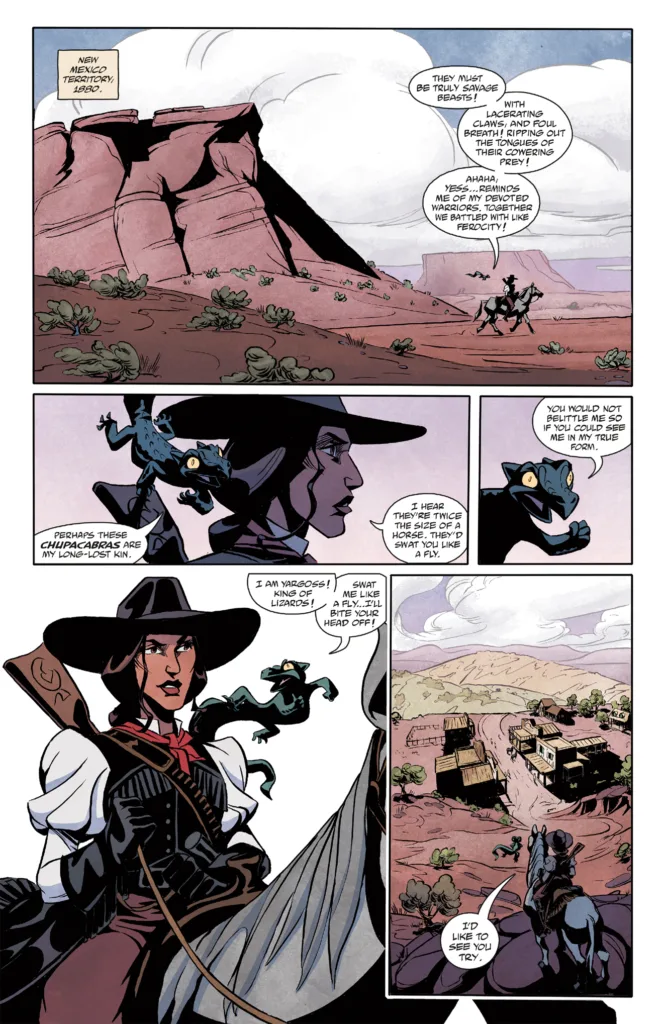
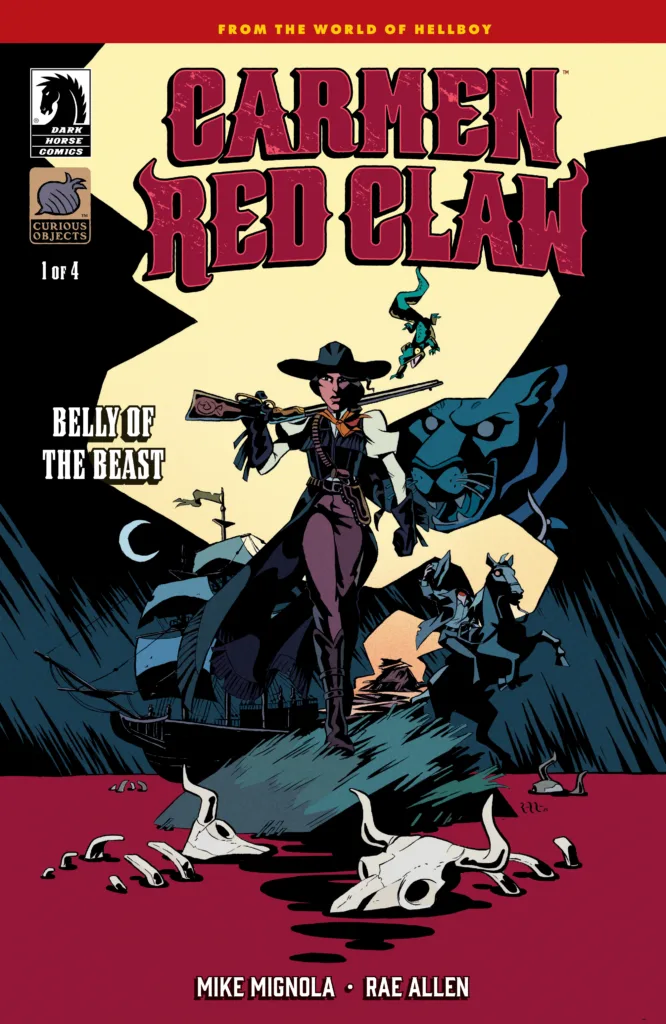
“My primary goal was to make Carmen look iconic,” Allen told Comic Book Club. “The specifics of her origins – daughter to a Spanish fur trapper and a Lakota shapeshifter, granddaughter to an infamous privateer, and now a well-to-do, self-sustaining, supernatural gun for hire – all combined to inform her design. I gave her a riding cape and puffed sleeves to convey elegance, big gloves and a contrasting red ascott as a callout to Lobster Johnson, and a long braid as an homage to her Lakota heritage. I knew I needed to put a lobster claw on her somewhere, and it was Mike’s brilliant idea to stamp her rifle with her family’s cattle brand.”
To find out much more about the book, Carmen Red Claw’s weird lizard companion, and the trick to drawing a disturbing baby, read on.
Comic Book Club: What was important in the design of Carmen Red Claw? What were the essential characteristics you wanted to capture?
Rae Allen: My primary goal was to make Carmen look iconic. The specifics of her origins – daughter to a Spanish fur trapper and a Lakota shapeshifter, granddaughter to an infamous privateer, and now a well-to-do, self-sustaining, supernatural gun for hire – all combined to inform her design. I gave her a riding cape and puffed sleeves to convey elegance, big gloves and a contrasting red ascott as a callout to Lobster Johnson, and a long braid as an homage to her Lakota heritage. I knew I needed to put a lobster claw on her somewhere, and it was Mike’s brilliant idea to stamp her rifle with her family’s cattle brand.
Carmen has a lizard shoulder demon companion… Similar to the last question, what were you hoping to convey with his (its?) design?
Pest started out as a purely aesthetic choice, to help Carmen feel more supernatural. He has grown to develop a much deeper backstory (which you’ll learn more about in the Miss Truesdale series somewhere down the line, or so I’m told), but I won’t spoil anything here. Ultimately I wanted a devilish-looking lizard with a long tail and was somewhat cute–which is infuriating to him because he still views himself as a bloodthirsty warrior. I patterned him off of a bunch of lizards, but leaned toward a bearded dragon because Katii, my editor, mentioned she had one of those.
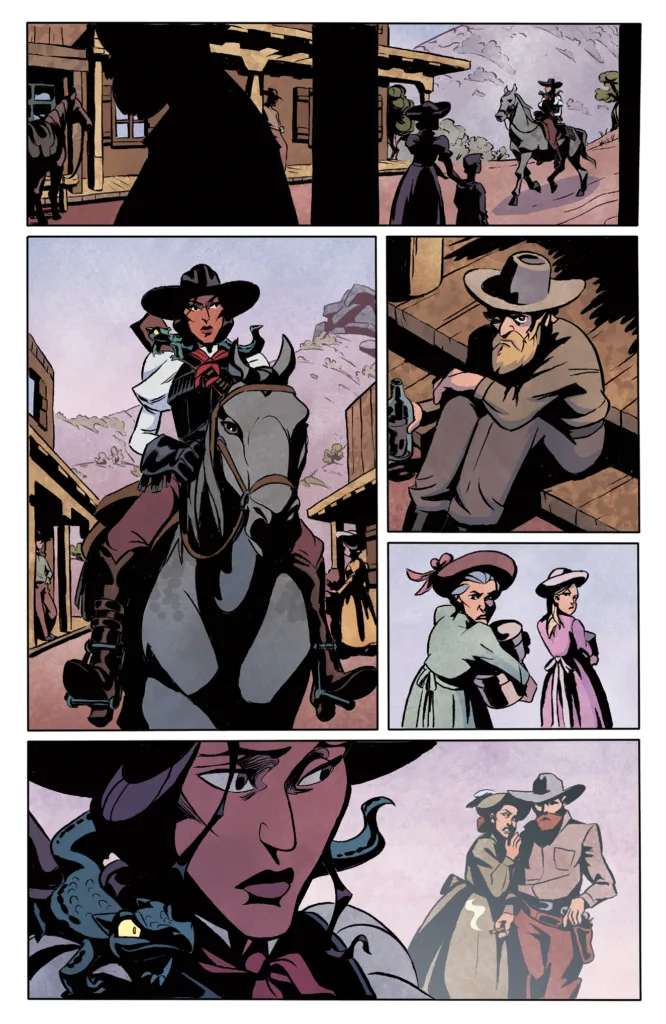
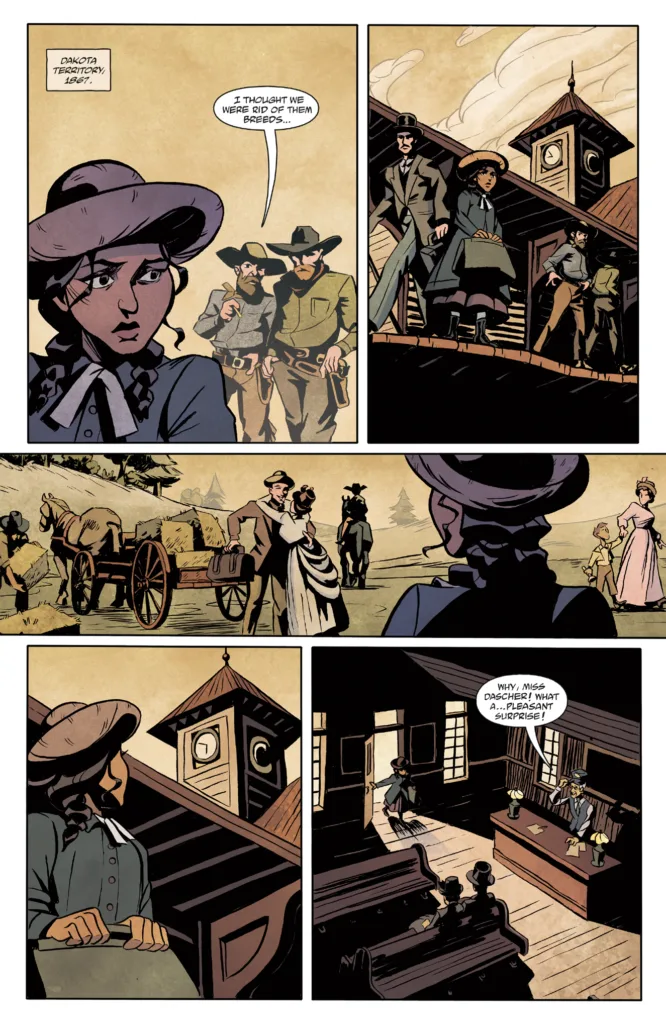
The Western setting is very different from a lot of the Mignola-verse… How do you make sure it feels connected, while being in a different geographical location and time period?
For me, what makes a story feel like Hellboy is deep historic research and strong folkloric influences. Most settings in the Hellboy universe are dilapidated, haunted, and ancient-looking, contrasted with intricate turn-of-the-century technology. So my goal is to create the same feeling in the old west using rustic ghost towns, ancient ruins, souped up trains and overengineered explosives. And of course populating the world with the occasional local cryptid (or old-world cryptid, brought overseas by colonizers).
You’ve clearly got a style of your own, but there’s one panel in the book with these rats who look very Mignola. Given his signature style, when do you lean into that, and when do you lean out?
Haha! Funny you bring that panel up, because it is one of the few I pretty explicitly referenced Mignola’s work for. It’s such a Mignola moment, so I thought it fitting to lean into it there. As for the rest of the book, I kind of drew it in a way that felt natural. Sometimes that meant leaning into more of my artistic influences, Mike included, and sometimes it pushed toward something more standalone. I don’t really try too hard to control it, most of the time it just happens.
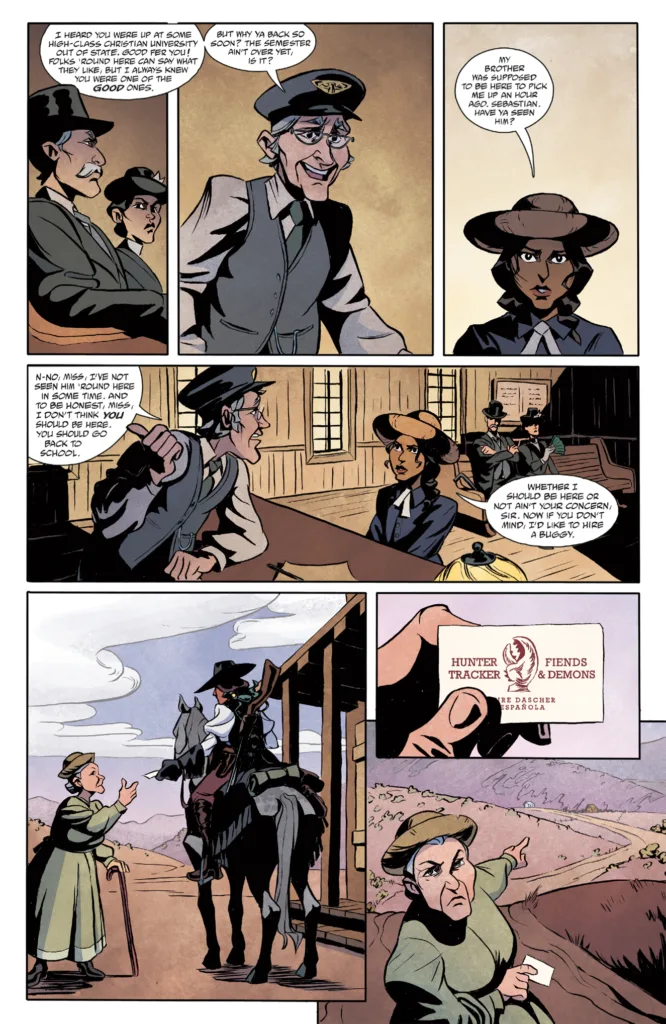
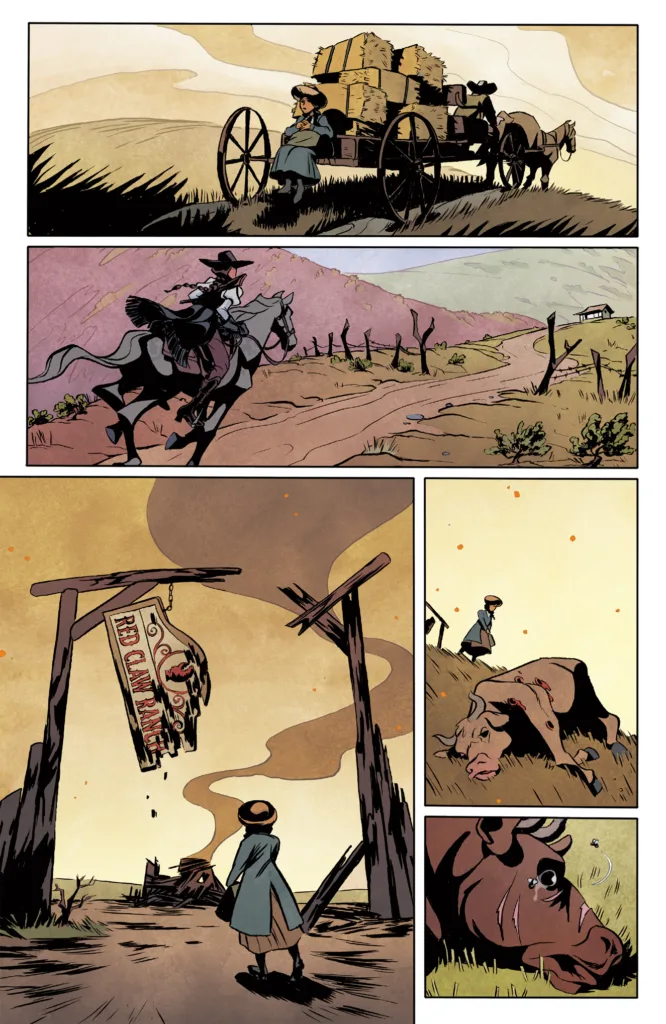
You’ve got some great action scenes in here that are sparse in the dialogue. I know this is part and parcel with the comic book form, but what’s important in crafting action that works without words?
I’ve always been obsessed with finding ways to show a story, rather than tell it, which is one of the things I love most about the comics medium. When I draw an action scene, I’ll go into full-on choreography mode, map out the scene, and pace out a play-by-play. I try to maintain clarity by establishing the environment, limiting actions down to just 1-2 per panel, and giving as many indicators of directional motion as possible using secondary motion (flying capes, tassels, hair, etc) as well as anticipated motion (reeling back for a punch). I’m inspired by films like Indiana Jones or Pirates of the Caribbean, which all have really clear and engaging action sequences that utilize the environment and tell a story about each character, all while using dialogue sparingly.
I don’t know if this is too much of a spoiler, but what’s the trick to drawing the perfect weirdo baby?
Hehehe… I’m delighted by how strange that baby is to everyone who sees him. That was most certainly the goal! I think the biggest tip I have for anyone trying to draw something that looks wacked-out, give it wall-eyes. If those pupils aren’t focused, it either means no one is home, or something very sinister lurks behind those eyes.
Carmen Red Claw #1 is in stores now.
Comic Book Club Live Info:
Discover more from Comic Book Club
Subscribe to get the latest posts sent to your email.