










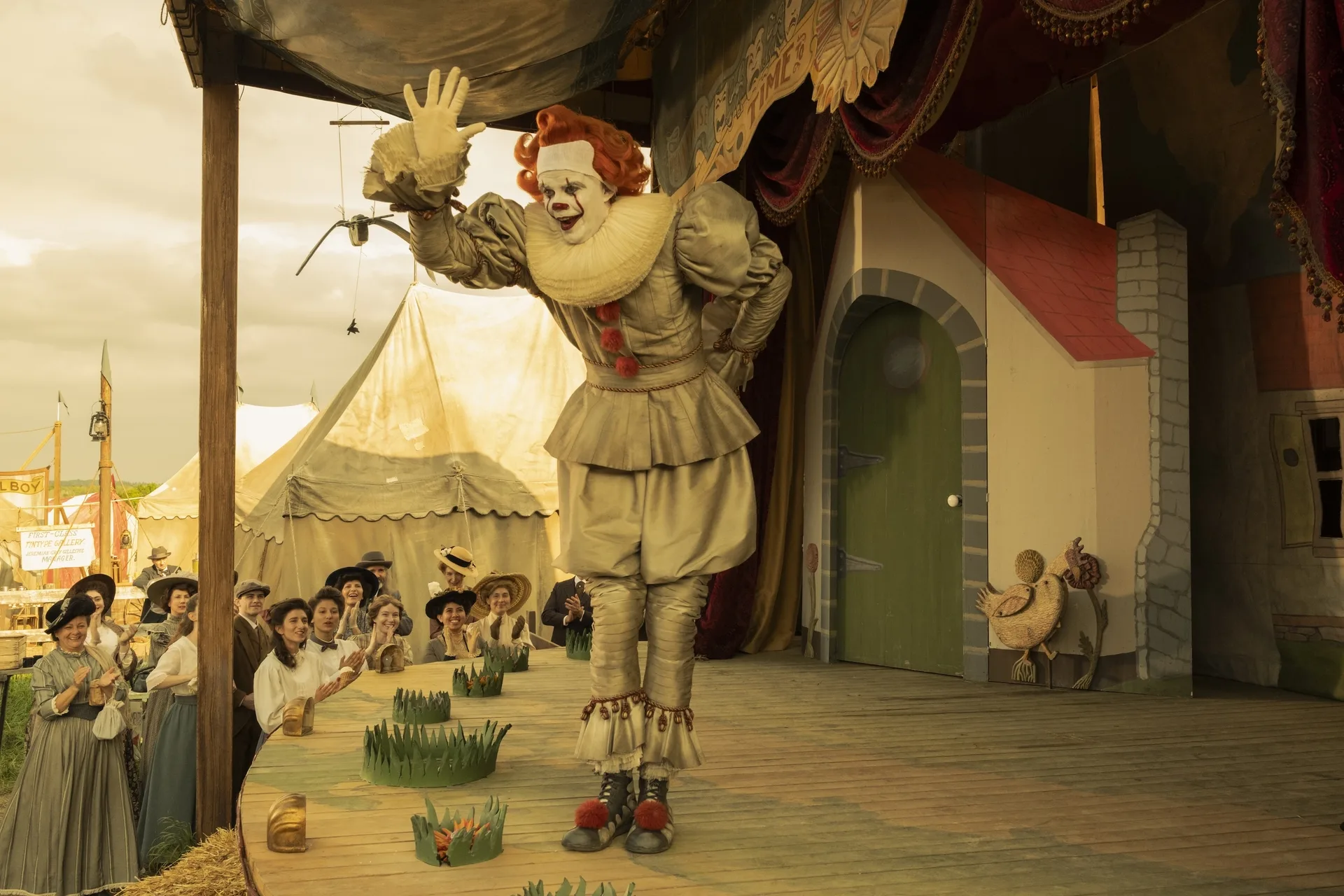
In this week’s episode of IT: Welcome to Derry on HBO – and spoilers past this point – we meet the real Pennywise the Dancing Clown. Not the monster, IT, who has been living in the sewers of Derry and eating children for decades. But rather, the human being Bob Gray (Bill Skårsgard) who was the real Pennywise back in 1908, performing in carnivals with his daughter Ingrid (Emma-Leigh Cullum). And right at the top of the episode, we get to see a vintage clown routine from Pennywise, with all the bells and whistles that entails.
Since the monstrous Pennywise viewers know and fear is never purposefully funny, this is the first time we’ve seen actual clowning from the character in any iteration, versus chowing down on human heads. But how accurate is this routine to the time period? Is Pennywise (the real one) a good clown? And what about Skårsgard? To find out, we went to the source: a historical clowning expert who performs in a horror circus. Seriously.
Steve Copeland is currently a performer on Paranormal Cirque, which he describes as “a great marriage of horror and circus” that is rated 17+ and regularly performs all over the country. He’s also part of the duo Steve & Ryan with fellow clown Ryan Combs. And the cherry on top is that he’s on the board of directors of the International Clown Hall of Fame and Research Center in Baraboo, Wisconsin.
Copeland first became interested in clowning when he was four years old, watching the 20th anniversary of Ringling Bros. special on CBS. Years later, he joined the iconic circus himself, spent five years on the road, and in the process became obsessed with clowning history. Copeland recalls grabbing up “old Ringling programs, circus programs, studying them,” and then picking up vintage video collections as well. While his expertise pertains mostly to Ringling Bros. history, particularly between the late ‘60s until the 2000s, when he left the circus, he does also dabble in 1900s circus, and further back – per the point of this piece.
Also, not so coincidentally, Copeland points to Ringling Bros., Barnum & Bailey Circus, which began performing as one entity in 1871, as a good starting point for the historical context here. “At that point, circuses were getting bigger,” Copeland noted. “The older circuses, the role of the clown, it was much more intimate, and there were one ring shows where the clown could be heard by the audience. So the clown was an orator. They could tell jokes, they could sing songs, they could do acrobatics.”
As the circus grew and things expanded from one ring to three (like Ringling) under huge tents, “The audiences were getting farther away, and so the talking, singing clown was going away. And that’s when clowns began doing very broad visual clowning, slapstick, easy to understand visual humor that could be seen from a far distance. And that’s also when you started to see the more exaggerated clown makeups, with the all white face and the makeup put on grotesquely big mouths, big eyes, big red noses, crazy wigs, and also more outlandish costumes.”
Copeland adds that a lot of clowns from the time period did have lighter colored outfits like Pennywise, alongside the white faces, to help being seen from far away. Copeland also explained that versus the “amateurish” clown costume that Tim Curry wears in the 1990s TV version of IT, the one sported by Skårsgard in the movies IT, IT: Chapter Two, and TV show Welcome to Derry is very reminiscent of those worn around the early 1900s, particularly that ruffles “made their way into that era of clowning.”
Curiously, IT costume designer Janie Bryant based Pennywise’s look on earlier eras ranging from Medieval to Victorian dress. And director Andy Muschietti, who also directed this week’s episode of Welcome to Derry, stated in an interview that, “aesthetically, I don’t dig the 20th century clown. It looks cheap, and it’s too related to social events and stuff and circus and stuff, which circus is fine, but I’m more aesthetically attracted to the old time, like the 19th century clown. And given that this guy has been around for centuries, I wondered myself why, why not, having an upgrade that was 1800s.” So perhaps the fact that Copeland thinks this works for 1908 is more of a happy coincidence than anything purposeful.
Back to Pennywise’s routine, though. In the hour, Pennywise has own dedicated stage where he initially comes out to be harassed by some wooden gophers, tries to steal flowers from them, and then transitions into a sad routine where he dances with the empty uniform of his deceased wife, who used to perform with him as Periwinkle the Clown. It ends with the children who were delighted watching Pennywise perform, storming the stage, ripping off Pennywise’s wig, and dancing like him. The whole thing is also pretty high tech for 1908, with levers, pulleys, and mechanized elements playing along with the routine.
As Copeland explains, this sort of setup is often seen at modern carnivals (minus maybe the mechanized gophers). “I have friends who perform clowning or comedy at fairs and carnivals, and they have their own stage,” Copeland said. “Maybe it comes out, folds out of a semi that they drive, and then that way, they’ve got their own performance venue in the circus at that time.”
Back in 1908? You wouldn’t see that sort of thing much at a traveling carnival, though it would be utilized at a midway to hype carnival-goers up for the sideshow, with clowns used “to add some color… There wouldn’t be a full performance. It would just be something to tease the audience enough to want to pay extra to go into the sideshow tent and see what was inside.”
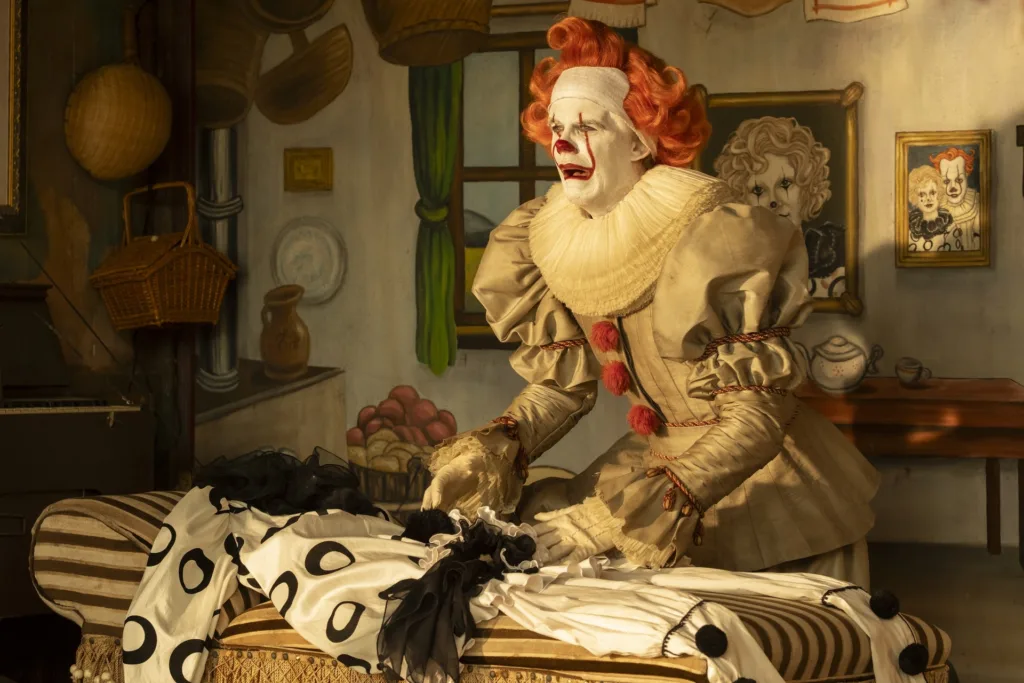
Okay, but how did Pennywise do, anyway? Is he a good clown? Copeland did note that the performance seemed very “theatrical,” something that is common with movies and TV shows in order to make things as “visual as possible.” Versus a very focused routine you might see in a real circus or carnival, think about how when a circus is on screen you see clowns performing, the high wire act on the trapeze, and horses running around all at the same time. “There’s 50 things going on at one time, because it’s much more visually interesting than just one single performance going on,” Copeland said. “So I know that’s got a lot to do with the liberties they take with his performance.”
But more specifically, Copeland – who clarified he is “super critical of other performers” as a “jaded clown” – explained that Pennywise used “a lot more effort than I’m sure any other performer was putting forth in 1908 so props to him for that. Audiences were definitely a lot easier to entertain back then.”
For example: right at the top of the routine, Pennywise comes out and trips and the audience of children laugh hysterically. “That is a little more along the lines of what would happen, as opposed to a 2025 audience watching this same kind of act.” So that part works, as does the “very clear cut, very cartoonish” bits Pennywise is doing with the gopher and the flowers.
“But then he goes into the whole Charlie Chaplin pathos thing of the dead wife,” Copeland added. “And you know that? That’s a little much to ask of audiences of that time, especially at a carnival.”
Copeland also conceded that he “wasn’t too crazy about the performance, but again, I would say that was probably better than what was going on in 1908. I will say he looked a lot better than probably most clowns did. There were a lot of clowns in 1908 that probably looked scarier than Pennywise does, even when he’s in his monster form. But also, he has the benefit of a Hollywood makeup artist doing his makeup and everything, because there’s some pretty grotesque looking clowns from that time period.”
While researching this piece, I discovered a Reddit thread including photos of clowns from the 1900s, and Copeland is correct: they are grotesque, making Pennywise look tame by comparison. Copeland went back to the point that the early 1900s were an “evolutionary period” where clowning went from “more intimate venues to the big top venues.” But he also noted there was a veritable arms race in the time period to boast about the number of clowns one had in their circus. And while they would crow about having 50 or 100 clowns, many of them were just workers on the circus they would “slap on clown makeup and a costume” so they could walk in a parade. “It’s a combination of those things, of why clowns were looking kind of rough at that point. It was clowning’s awkward teenage years.”
Wait, hold up a second… Is this time period where America’s fear of clowns came from? Particularly given IT takes on the form of Pennywise on Welcome to Derry explicitly because children clearly love the human version? While Copeland did note that anyone in a costume, from Santa Claus to the Easter Bunny can be scary, and that the trend in movies and TV was definitely “jump started” by Stephen King’s IT, he pointed not to janky 1900s clowns or Pennywise for the widespread coulrophobia, but a more surprising source: “well intentioned amateurs.”
“It’s people that want to go out, they want to entertain, they want to make kids laugh, which is all fantastic, but if you go at it without the proper skill or training, unfortunately, you can do more damage than good,” Copeland said. “If you have scary makeup, if you’re performing like you think a clown is supposed to perform, and you’re in this kid’s face doing a big Bozo laugh, the kid’s gonna crap their pants. A lot of damage has been done by well meaning amateurs that just have not taken the time or put the effort into making themselves the best they can be, and clowns like Pennywise and Art the Clown from the Terrifier series, that’s a much easier thing to pin on kids being afraid of than looking in the mirror and saying, ‘Well, what am I doing that could be frightening to children? Or what could I do to make my performance better or or less terrifying?’”
When I confronted Copeland about his assertion that amateur clowns are worse than child-eating sewer clowns, he laughed, and added, “both have done damage. But child-eating sewer clowns are easier to keep from kids, because as a parent, you could say, ‘No, I don’t want you watching this,’ whereas the amateur clowns you’re going to encounter them at birthday parties, at parades and stuff like that. And again, not saying all amateur clowns are bad, but there are some that are. And there’s even some professional clowns that could take a lesson about being less obnoxious or terrifying. I just don’t think it’s fair to just blame the horror movie clowns.”
That’s probably a big relief for Pennywise, but to get back to the performance in the episode, one aspect we haven’t touched on is how his wife used to be part of the act… And before he likely gets ripped to shreds by IT (the event happens off-screen, so TBD on that), Bob Gray is delighted to find that his daughter wants to succeed her as the new Periwinkle in a father-daughter act.
“The circus is very generational,” Copeland said in response to whether this was the sort of thing you’d see in real life. “Especially back in that time, there were big family acts that did the trapeze, teeterboard stuff like that. And even today, you’re going to see husband and wife clowning acts or comedy acts… I’m sure there have been father-daughter or father-son as well. So especially in the circus and carnival, family definitely is something you’re going to see in an act, because it’s another person to help you bring an income.”
Speaking of family, what about Bill Skårsgard himself? Does he have the chops to make it as a clown, and perhaps bring some other Skårsgards into the act?
“Bill Skårsgard can do anything that he sets his mind to,” Copeland said. “He’s definitely performing it in the style of silly, clumsy clown and everything. If he put his mind to it and got the right guidance, he could be a good clown. So it’s just a shame that a shape-shifting entity takes his form, because I think that’ll ruin his chances.”
IT: Welcome To Derry Premiere Dates And Episode Guide:
New episodes of IT: Welcome To Derry premiere on Sundays on HBO and HBO Max at 9pm ET.
Here’s the full list of episodes in IT: Welcome to Derry Season 1 with premiere dates:
- Sunday, October 26, 2025: IT: Welcome To Derry, Season 1, Episode 1
- Sunday, November 2, 2025: IT: Welcome To Derry, Season 1, Episode 2
- Sunday, November 9, 2025: IT: Welcome To Derry, Season 1, Episode 3
- Sunday, November 16, 2025: IT: Welcome To Derry, Season 1, Episode 4
- Sunday, November 23, 2025: IT: Welcome To Derry, Season 1, Episode 5
- Sunday, November 30, 2025: IT: Welcome To Derry, Season 1, Episode 6
- Sunday, December 7, 2025: IT: Welcome To Derry, Season 1, Episode 7
- Sunday, December 14, 2025: IT: Welcome To Derry, Season 1, Episode 8 *Season Finale*

Where To Watch IT: Welcome To Derry





Comic Book Club Live Info:
Discover more from Comic Book Club
Subscribe to get the latest posts sent to your email.